
Introduction
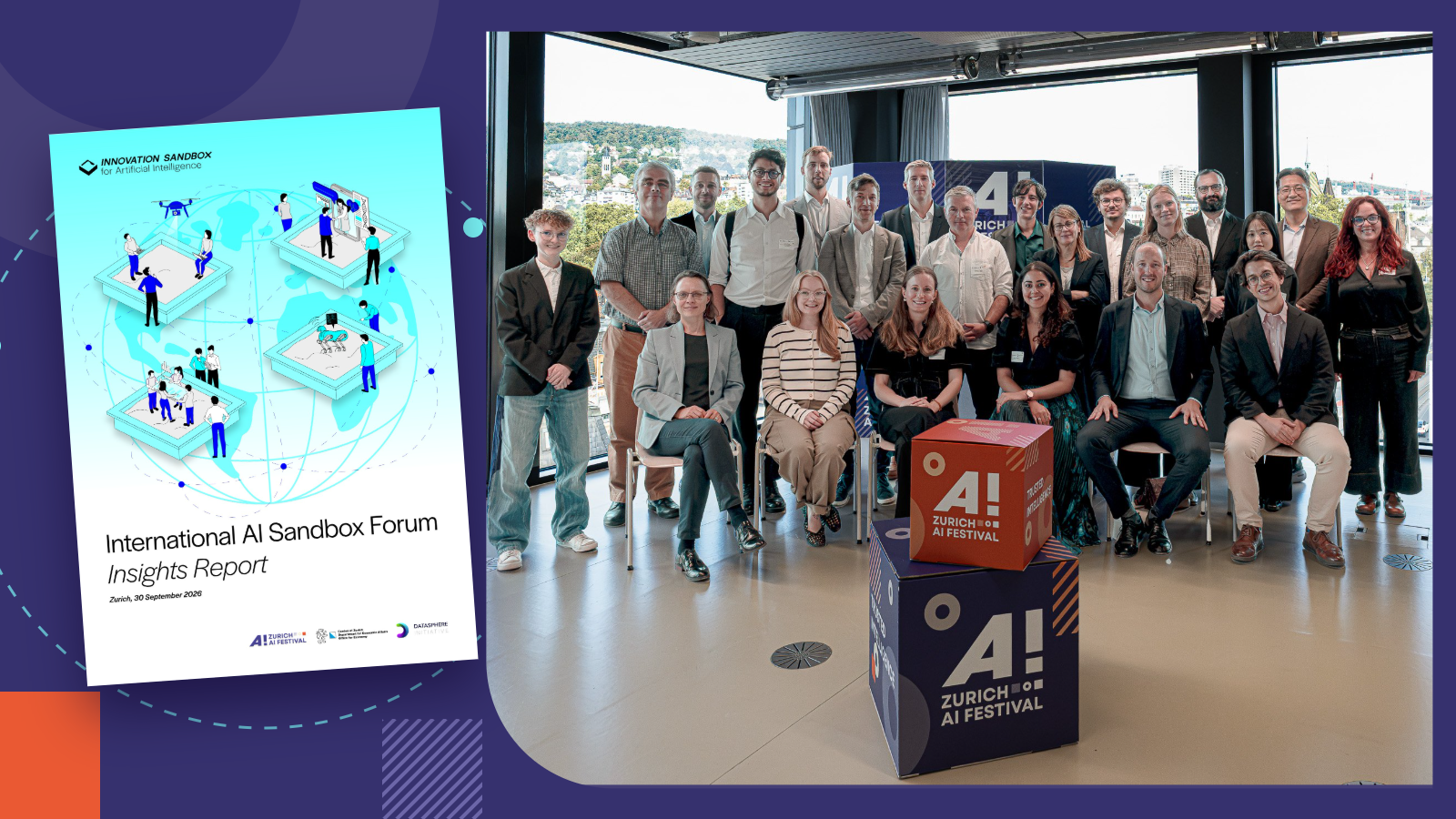
Regulators are learning what AI sandboxes can do for them. Companies, civil society and academia are still asking what sandboxes can do for them. The International AI Sandbox Forum Insights Report, published today by the Canton of Zurich and the Datasphere Initiative, sets out what practitioners have learned about closing that gap.
The report draws on an exchange between countries at different stages of their sandbox journeys. The two organisations co-hosted the International AI Sandbox Forum on 30 September 2026 as part of the Zurich AI Festival 2026. There, 51 participants from Swiss public administration, academia, the private sector and civil society compared notes with public officials from the United Kingdom, Spain, Germany, Liechtenstein, Korea, Brazil and the United Arab Emirates. This post shares seven lessons from the report.
What is an AI sandbox? Opening the Forum, Sophie Tomlinson (Deputy Executive Director, the Datasphere Initiative) defined it as
“a controlled learning environment in which AI systems, use cases, or related governance approaches are tested under defined conditions, timeframes, and safeguards (…) to inform both innovation and governance.”
Regulatory sandboxes offer experimentation under the guidance of public authorities. Operational sandboxes provide technical environments, data or tools. Hybrid sandboxes combine both.
This definition builds on the Datasphere Initiative’s earlier reports, Sandboxes for Data (2022) and Sandboxes for Digital Public Infrastructure (2026).
7 lessons on AI sandboxes from the report
The International AI Sandbox Forum Insights Report captures the discussions in full. Its lessons speak to a challenge described by Sophie Tomlinson:

“Tech moves fast, governance slowly. These are things we know. What’s sometimes less clear is how governments can better understand AI use cases, regulatory challenges, risks, opportunities, take informed decisions and evolve their capacities.”
— Sophie Tomlinson
Here are seven lessons from the report.
- Screen participants for readiness. Startups may lack the regulatory maturity to take part, while mature companies may fear delays to their time to market. A pilot run with academic partners can help refine the design before scaling up.
- Set expectations from the start. Definitions of a sandbox can differ, even within one authority. Clear communication, onboarding and training help teams, participants and stakeholders share the same understanding.
- Focus on specific legal requirements. In Spain, a pilot observed by the Spanish Agency for the Supervision of Artificial Intelligence (AESIA) helped companies turn AI legal requirements into a practical roadmap. Tackling specific requirements, rather than all of them at once, proved more useful, and access to several regulators mattered to participants.
- Measure against the sandbox’s own goals. Sandboxes are too diverse for one set of indicators, and not every experiment will succeed. Ask the wider industry, not only participants, whether the resulting guidance proved useful.
- Go hybrid with care. Combining regulatory guidance with access to data and compute, as the UK Financial Conduct Authority’s Supercharged Sandbox does, can attract companies. But hybrid models need new expertise, so map legal and technical needs, data partners and safeguards first.
- Involve civil society through concrete use cases. Few AI sandboxes engage the public today. Not-for-profits can act as facilitators and civil society organisations can bring in the needs of affected communities, especially in areas such as AI in the workplace or healthcare.
- Share lessons across borders. Cross-country sandboxes are needed but are still at an early stage, and practitioners face similar challenges wherever they work. Maria Esteller Fernandez (Deputy Director-General of AESIA) stressed the value of this exchange for Europe.

“Cross-country sandbox transferability or learning will be especially useful in the case of the European Union where coordination is not easy. Countries will find it useful to share knowledge between different member states.”
— Maria Esteller Fernandez
Where the insights come from
The Forum combined a public morning with a closed-door afternoon for governments.
In the morning, Sophie Tomlinson (the Datasphere Initiative) explained how sandboxes connect to AI governance, and how the Datasphere Initiative works with governments that design them. Raphael von Thiessen (Programme Lead AI Hub, Canton of Zurich) then presented the Canton’s Innovation Sandbox for AI. Launched in 2022, it has tested AI products and services in sectors such as agriculture, health and mobility. Their presentations opened two public panels on regulatory learning and the wider AI ecosystem.
In the afternoon, governments with sandbox experience met behind closed doors to work through three questions: how to measure impact, how to involve the public and stakeholders, and how to combine operational and regulatory sandboxes.
For Raphael von Thiessen (Canton of Zurich), the value of the Forum lies in bringing sandbox teams together.

“AI sandboxes are developing rapidly around the world. Bringing the people behind them together allows us to share what works, learn from different approaches, and explore opportunities for international collaboration.”
— Raphael von Thiessen
Learn more
Read the full International AI Sandbox Forum Insights Report.
This exchange is at the heart of the Datasphere Initiative’s mission: equipping public authorities and stakeholders around the world with the evidence, tools and networks they need to responsibly unlock the value of data for all. As AI sandboxes grow in number and maturity, the open question is whether they will change not only AI rules, but also how policymakers work in the digital age. Networks such as the Datasphere Initiative’s Global Sandboxes Forum offer a steady platform for this exchange.
Join the Global Sandboxes Forum to exchange with AI sandbox practitioners worldwide.
About the hosts
The Datasphere Initiative is a global think-and-do-tank shaping the future of data governance by connecting policymakers, innovators, researchers, and civil society to co-create solutions for responsible data use.
The Canton of Zurich, through the Office for Economy of its Department for Economic Affairs, runs the Innovation Sandbox for AI. Since 2022, the sandbox has helped companies test AI solutions in real-world settings with the support of the Canton and relevant regulatory authorities.