

One discussant from Brazil, one from India and one from South Africa gathered to debate one question. Global South countries have issued a decade of shared declarations on digital rules, yet South-South digital diplomacy still lacks real agenda-setting power. What is missing? Is it a lack of political will, or a lack of technical capacity?
On 4 November 2026, the Datasphere Initiative, the Human Sciences Research Council (HSRC) and the University of Johannesburg’s Centre for African Diplomacy and Leadership (CADL) hosted the 90-minute webinar From Alignment to Agency: South–South Digital Diplomacy and Collective Leverage, which brought together participants from 19 countries, from Kenya, Ghana and Egypt to India, Timor-Leste and Colombia. This post looks at the proposition that framed the debate, the answers from each discussant and the three conclusions that emerged.
Moderated by Robyn Ehryn Williams, Research Manager at the University of Johannesburg, the debate gathered Arthur Mutambara, former Deputy Prime Minister of Zimbabwe and Director of the University of Johannesburg’s Institute for the Future of Knowledge; Vinay Narayan, Associate Director at Aapti Institute; and Lorrayne Porciuncula, Executive Director and Co-Founder of the Datasphere Initiative. Odilile Ayodele, Senior Research Specialist, chaired the session on behalf of the HSRC.
Defining South-South digital diplomacy: the proposition on the table
Ayodele set the scene with a three-fold proposition. First, a decade of shared declarations among Global South countries on AI and data governance has brought little negotiating leverage. Second, the reason is not political will, but a lack of capacity: the standing technical, legal and institutional “machinery” needed to hold a position once it is taken. Third, sandboxes are one of the few tools capable of building that machinery directly.
She then provided a definition of digital diplomacy:
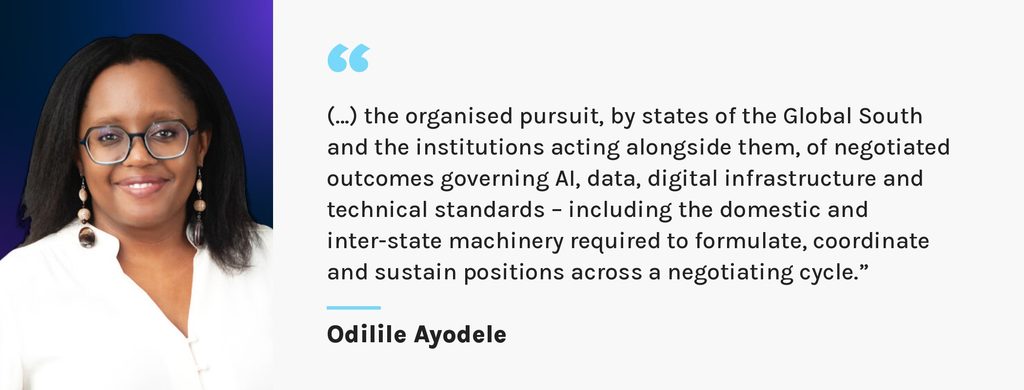
She emphasized that, while the term includes standard-setting bodies, trade negotiations, regulatory cooperation and multilateral diplomacy, it does not cover the use of digital platforms for public diplomacy. Another key aspect is the choice of the word “diplomacy” over “governance”. The former brings three things into view more accurately: the negotiating cycle and its deadlines, the domestic preconditions for holding a position, and the difference between having a preference and being able to trade on it.
What is a sandbox? The Datasphere Initiative defines sandboxes as “controlled learning environments designed for structured experimentation under defined governance frameworks, timeframes, and built-in safeguards to support iterative, multi-actor collaboration and evidence-based decision-making”. Sandboxes can be regulatory (with a regulatory learning objective), operational (with technical learning on real data or infrastructure) or hybrid (both at once). Access the report Sandboxes for DPI: Co-creating the blocks of digital trust, 2026.
The webinar followed a debate format in three blocks. First, the moderator put an opening question to each of the three discussants. Second, the discussants debated shared questions posed by the moderator. Third, the floor was opened to questions from attendees.
Sandboxes as strategy, not pilots: making urgent issues unavoidable
Williams first asked Porciuncula whether sandboxes can strengthen a state’s or institution’s negotiating position and, if so, what would allow them to do so.
Porciuncula stated that long multilateral negotiations typically dilute ambitions until only the lowest common denominator is left. That can be useful for reaching common ground on complicated issues, like data governance, but it rarely moves the needle on what needs to be done. Global South countries typically arrive at those processes as invited guests rather than as the ones setting the agenda. Sandboxes are a way to stop reacting to those processes and start acting on concrete matters.
According to Porciuncula, sandboxes bring several benefits. They test safeguards for privacy or inclusion before deployment at population scale. They put regulators, policymakers, companies, civil society and academia around the same problem, creating trust. And they allow failure to become information, so mistakes are part of the process rather than a reputational risk. She described the resulting idea of “versioning” regulation and policy, adapting as you go and embracing uncertainty, as quite revolutionary.
Porciuncula gave Brazil’s instant payment system, Pix, as an example of change enacted through a sandbox. The Central Bank of Brazil convened an international workshop in 2016 and then a working group for an instant payment sandbox, from which Pix emerged. Today Pix covers billions of transactions. Its success and scale did not stop the Central Bank from creating the Pix Forum, which keeps iterating on the solution with market players and affected communities.
Her second example came from Brazil’s recent elections, in which ordinary people were given concrete missions and tasks through coordinated civic action. That mobilization pushed topics into the center of the national conversation. It did not wait for permission. It made issues unavoidable for the conversation.
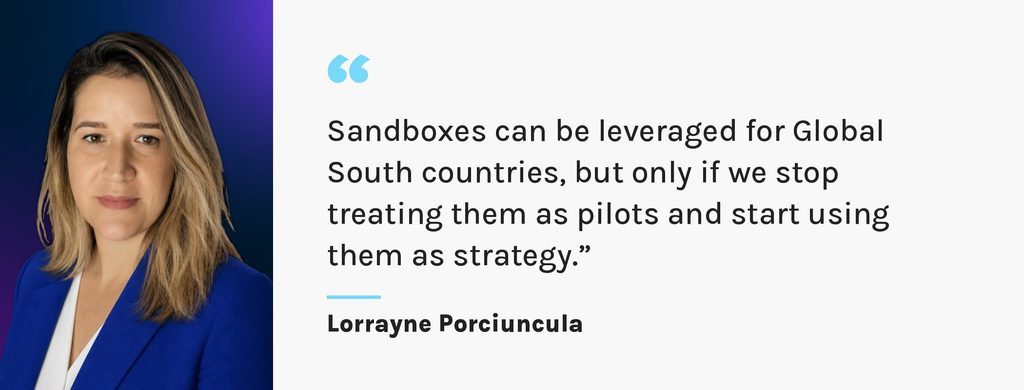
Porciuncula‘s key message was that this kind of dynamism can be brought into cross-border contexts. The Global South can do the same with digital governance by running short, mission-driven sprints: framing problems, designing solutions to concrete objectives, bringing people together and delivering results. Sandboxes can provide that energy, method, mandate, safeguards, timeframe and learning loop.
If Digital Public Infrastructure is a vehicle for AI, who benefits?
Williams asked Narayan what coordination and leverage actually materialized after the India AI Impact Summit and India-Africa cooperation on digital public infrastructure (DPI), and for whom.
Narayan said that little coordination came out of the Summit itself. In his view, India largely used it to showcase its own AI and DPI innovations, and references to South-South cooperation often amounted to tokenism. The coordination that did happen was among civil society organizations (CSOs), which had more space at this Summit than at previous ones.
What the Summit did strengthen were ties around DPI, which India sees as soft power for itself. According to him, India’s goal when pushing the DPI agenda is less about coordination and more about building soft power. Narayan echoed Porciuncula in pointing to Brazil as a potential leader of Global South cooperation, citing the grassroots mobilization around digital issues during its recent elections.
Regarding the India-Africa tie, Narayan explained that India has exported many of its DPI products to Africa, but that this should be seen critically. Within India, DPI has faced two main criticisms. First, there is no clear data governance in DPI mechanisms, so private actors end up benefiting the most. Second, DPI acts on existing disparities and systemic issues, especially in digital literacy and digital connectivity.
A key question follows: if DPI is pushed as a vehicle for AI, with its data used to train AI systems, who is developing those systems? Narayan stated that most Global South governments lack the capacity to build large language models (LLMs), so DPI as a data pipeline for AI inevitably ends up benefiting private companies. Global South countries are then seen as testbeds for AI, as opposed to actually benefiting from it, innovating with it and creating it.
Political will and capacity: both are in short supply
The question Williams put to Mutambara, drawing on his experience inside government, was whether the constraint on global leverage is capacity or political will. “Political will and capacity. Both are in short supply,” Mutambara stated.
First, he argued that political will is essential: without it, there is no movement. In the digital and AI revolution, scale and numbers are decisive. For that reason, African and Global South countries sometimes need to give up elements of national sovereignty to embrace the region and the continent.
On capacity, Mutambara presented five layers of the AI revolution: (i) energy; (ii) chips, including GPUs, CPUs and NPUs; (iii) infrastructure, data centers and AI factories; (iv) large language models; and (v) applications. To be creators of AI systems, he said, Africa must play in all five layers, which in turn requires digitization, digitalization and digital transformation. No single African country can achieve this alone. It requires unity among all Africans.
Finally, Mutambara answered those who might find this too ambitious. Global industries such as the energy transition, advanced manufacturing, defense electronics and aerospace depend on critical minerals, and Africa holds about 30% of global reserves. “Why don’t we leverage our natural resource base to be players in the AI revolution (…)?”, he asked. “So yes, we need both political will and capacity on the continent.”
Three conclusions: South-South cooperation, contextual capacity and concrete tools
The opening questions were followed by shared questions and a cross-debate among the discussants, which led naturally to a three-fold conclusion.
1) Global South countries must work together
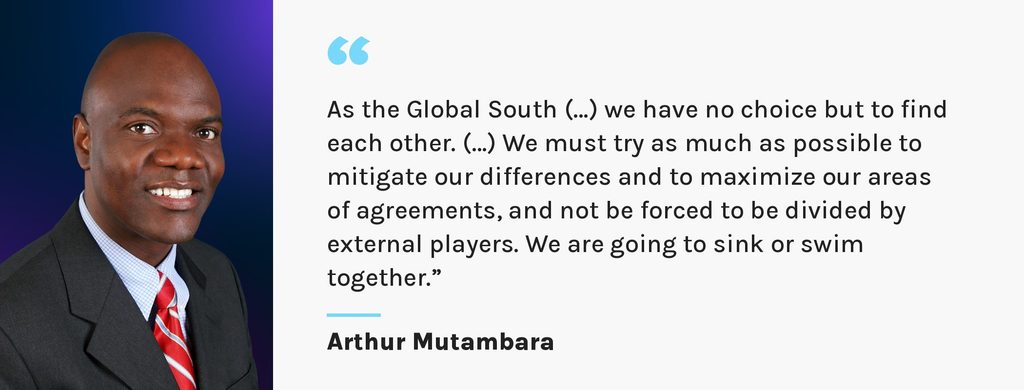
Mutambara emphasized the importance of regional coordination. He pointed out that five unelected men in Silicon Valley control AI, which he called digital colonialism and AI imperialism. Global South countries must therefore understand that the stakes are high, and act to democratize the digital revolution and decolonize AI.
Porciuncula added that Global South actors spend a lot of time defining and redefining digital sovereignty, and diverge on how to apply it, for example whether data must be kept in the country or whether contractual clauses are enough. Meanwhile, Big Tech companies have no issue calling their services “sovereign”, appropriating concepts that were developed for very different objectives. Porciuncula argued that disagreeing on concepts can be a distraction from what really matters: the actual policy objectives, such as improving people’s well-being and capturing value from data.
Echoing both perspectives, Narayan stated that Global South countries should stay away from the “red herrings” (distractions) constantly thrown at them and recognize the talent that exists across the Global South. In his view, these countries need to work together because they will be affected the most, and they must act to protect their own interests.
2) Capacity must be contextual, and people must be heard
According to Narayan, Global South countries should build AI systems that reflect their own contexts, rather than relying on companies based in China or the US. He called for smaller, more contextual AI models that consume fewer resources and address concerns such as agriculture and climate action, since Global South countries are the most vulnerable to climate change.
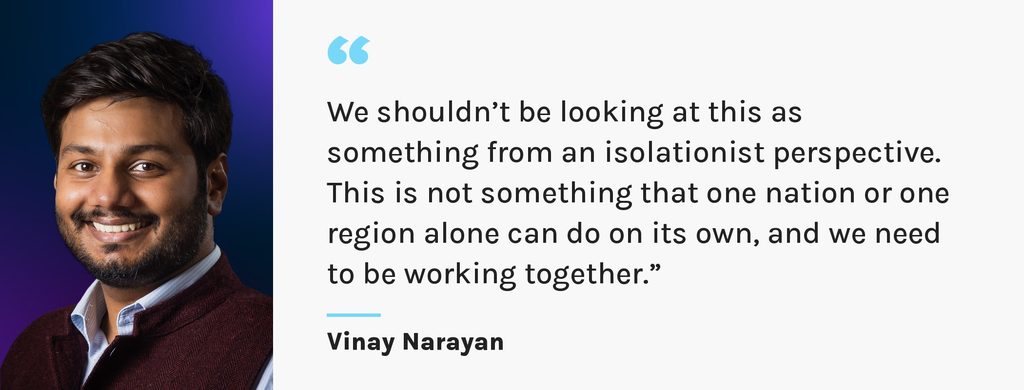
Narayan also pointed out that governance declarations are mostly predicated on a digital world closer to the Global North’s reality than the Global South’s. In India, for example, more than half of 1.4 billion people are not digitally literate or lack access to digital services.
Asked what a mid-sized Global South country with a single digital policy official should do first, Narayan answered: ask people what they want. Before implementing digital policy, he said, it is important to assess existing levels of digitization and disparity and to bridge them, “because if you don’t bridge that, anything you do will act on top of that existing disparity.” Porciuncula added that this is the approach behind the Datasphere Initiative’s work in Brazil, where it is providing technical consultancy for E-Digital, the Brazilian Digital Transformation Strategy for 2026–2031. This work includes synthesizing public consultation contributions, facilitating multi-stakeholder workshops and consolidating the strategy’s vision.
3) Sandboxes bring freshness, creativity and a sense of urgency
Porciuncula stated that, although sandboxes are not a silver bullet that solves every issue, they are something very concrete to start with. They bring the freshness, creativity and sense of urgency that Global South countries embody so well. Mutambara agreed, but stressed that the big picture should not be overlooked. “The sandbox for me is a tree,” he said; the forest is the unity in Africa and in the Global South needed to achieve scale.
Narayan also agreed on the benefits of sandboxes and asked Porciuncula for examples of sandboxes run well even where government regulators are not up to the task. Porciuncula explained that it is a common misconception that only regulators can start sandboxes. Civil society organizations and the private sector have started them too, including cross-border ones such as an African sandbox run by a bank. Because regulators often work with tight budgets and small teams, many partner with associations, think tanks or other organizations to run sandboxes and bridge different stakeholders. A key factor for success, she said, is investing in capacity beforehand, so people know what a sandbox is and what good practice looks like. That is why the Datasphere Initiative created a capacity-building program on sandboxes, including the Sandbox Summer School.
Finally, Porciuncula affirmed that moving from declarations to action means treating sandboxes as strategies, not pilots. People need clear instructions on how to sandbox, and the system needs to be flooded with concrete solutions. Used this way, sandboxes can bring people together meaningfully, move beyond generic statements and create solutions that improve people’s lives and well-being.
Why this matters: from alignment to agency in South-South digital diplomacy
Summarizing the debate, Ayodele concluded that the challenges are many, but there are instruments to tackle them. Political will and capacity are two sides of the same coin. Sandboxes, although not a silver bullet, are a strategic tool that can create concrete change and transform people’s lives.
As the webinar’s title suggests, moving from alignment to agency takes more than a decade of declarations: Global South countries need the capacity to hold and trade positions in negotiations. Sandboxes give that capacity a practical form, building evidence, regulatory experience and cross-border working relationships before negotiators enter the room. This is the work the Datasphere Initiative is committed to: equipping public authorities and stakeholders around the world with the evidence, tools and networks they need to responsibly unlock the value of data for all.
As Porciuncula put it in her closing remarks, sandboxes can be how the Global South “stops waiting to be invited into processes and starts running their own.” The next step, in her words: “we need to keep this conversation going, and we need to start doing our own sprints to create the solutions that we need.”
Take the next step
Learn how to design and run sandboxes for data, AI and DPI: Register for the Sandbox Summer School, taking place in Lisbon from 5 to 9 July 2027.
This webinar was part of the Datasphere Initiative’s Africa Sandboxes Forum. Learn more about it and go deeper into the evidence.
About the hosts
The Datasphere Initiative is a global think-and-do-tank shaping the future of data governance by connecting policymakers, innovators, researchers, and civil society to co-create solutions for responsible data use.
The Human Sciences Research Council (HSRC) is South Africa’s statutory research agency and the largest social sciences and humanities research institute in Africa, producing policy-relevant research to inform government policy and public debate.
The University of Johannesburg’s Centre for African Diplomacy and Leadership (CADL) is a research and dialogue centre focused on diplomacy, leadership and security, working to strengthen Africa’s relations within the continent and with partners across the Global South and North.