



LISBON, Portugal — July 15, 2026 — On the sidelines of its immersive five-day Sandbox Summer School, a specialized program equipping policy and tech professionals with sandbox design skills, the Datasphere Initiative officially unveiled its latest publication: “AI sandboxes and the private sector: Emerging models and opportunities”. Held at the SANA Metropolitan Hotel, the launch event gathered international practitioners, policymakers, and tech innovators.
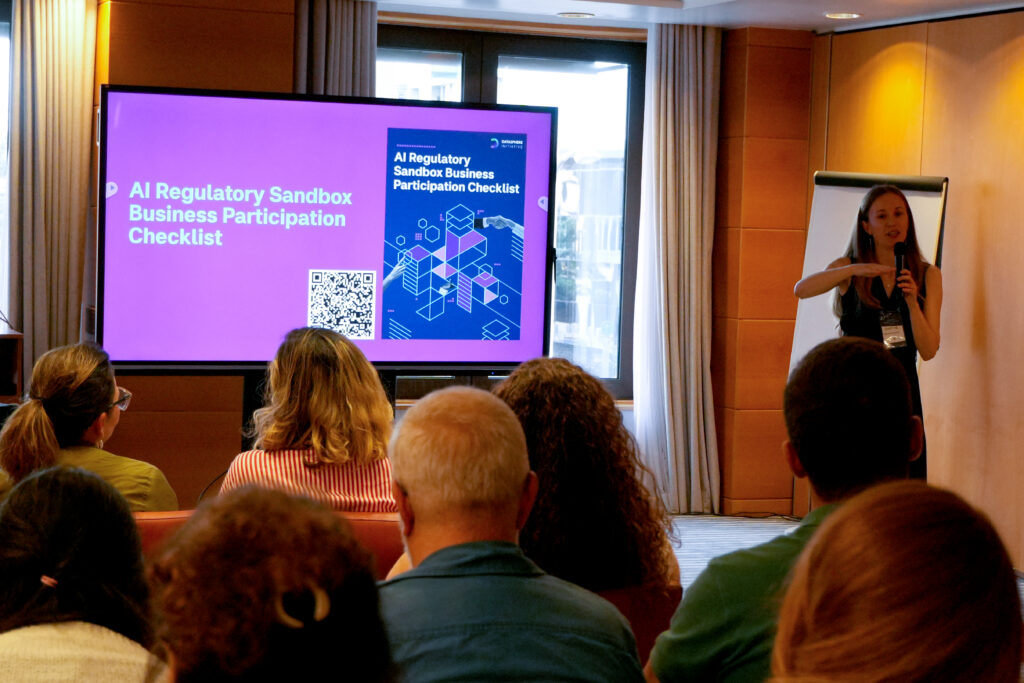
Presented by Lorrayne Porciuncula, Executive Director of the Datasphere Initiative, and Sophie Tomlinson, Deputy Executive Director, the study addresses a critical blind spot. While previous research has evaluated these frameworks primarily through a public-sector lens, the report focuses on the real-world commercial incentives and operational barriers that dictate why and how businesses of all sizes actually step into these testing spaces.
A new global baseline for AI experimentation
The rapid proliferation of artificial intelligence has reshaped business models while creating dual pressure on companies to innovate rapidly and navigate evolving, uncertain regulatory environments. AI sandboxes have emerged as structured environments where businesses, regulators, and other stakeholders can test technologies and governance approaches in a controlled setting.
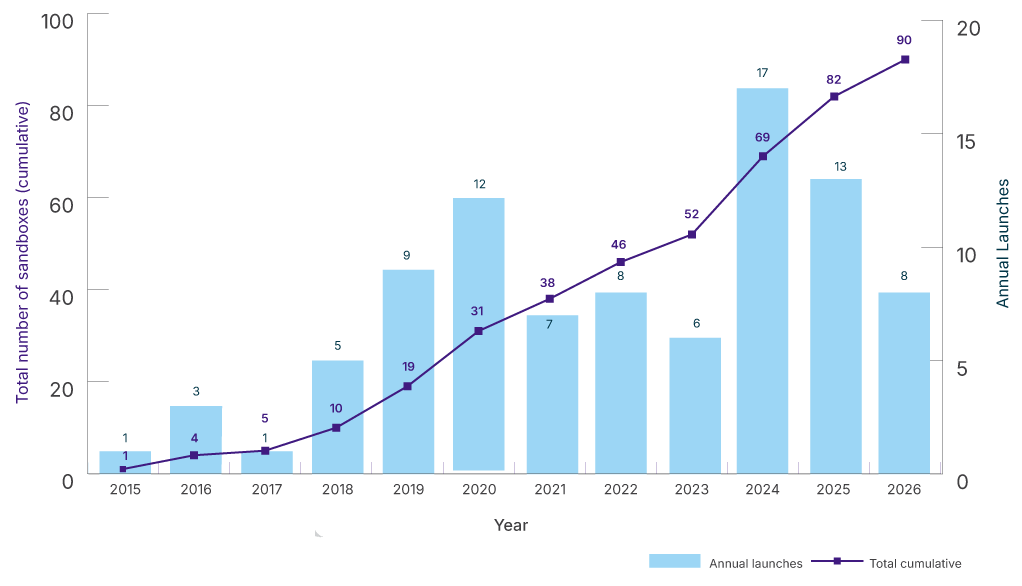
Total number of sandboxes (cumulative), featured in the report AI sandboxes and the private sector: Emerging models and opportunities
Building upon data from the Datasphere Initiative’s inventory of sandboxes, this report establishes a comprehensive global baseline for the ecosystem. The Datasphere Initiative plans to launch an online platform with its global sandbox mapping by the end of the year, and this report provides a sneak peak of its latest data on AI sandboxes:
- Unprecedented mapping: The study updates previous tracking to map 90 AI sandboxes across 39 countries, providing a global baseline of how these initiatives are evolving across continents and domains.
- Institutional diversity: The data collected shows that while the sample remains predominantly regulatory in nature (46 sandboxes), there is an increasing number of operational (15) and hybrid models (13) reflecting technical testing and infrastructure access alongside regulatory oversight.

“As countries worldwide look to use sandboxes as ways to support compliance with emerging regulations, boost AI innovation and adoption or democratize access to synthetic data and AI models, many are attempting to partner with or attract companies to their sandbox initiatives. We wanted to share our expertise and knowledge on what companies find attractive about sandboxes, and what can be concerning, so that sandbox designers are proactively building a sandbox that builds trust and delivers concrete results.”
— Lorrayne Porciuncula, Executive Director of the Datasphere Initiative.
Mapping corporate engagement: the three roles of the private sector
A core takeaway of the study is that business engagement in AI sandboxes is not monolithic, but reflects a spectrum of incentives, responsibilities, and governance implications. Across different AI sandbox models, private sector participation can be understood through three core roles shaped by company size, sector, market position, and technical capacity:
- Participants: Companies, often startups and SMEs, enter controlled environments to validate products, explore use cases, and improve compliance readiness under supervisory guidance before scaling.
- Technical providers: Businesses collaborate directly to sandbox design and implementation by supplying infrastructure, platforms, testing software, synthetic datasets, or compute resources to enable rigorous technical experimentation under real or simulated conditions.
- Sandbox hosts/operators: Technology firms act as infrastructure builders and operators, offering “sandbox-as-a-service” environments where prospective users can test models and try out tools within the provider’s ecosystem.
Unlocking tangible business value and overcoming friction
For startups and early-stage firms operating with limited capital, acceptance into a sandbox can operate as a form of external validation that enhances credibility, signals governance maturity, and increases investment appeal. Data from the OECD cited in the report underscores the strategic high stakes: by 2025, AI firms accounted for 61% of global venture capital investment, making regulatory predictability a major driver of funding and market stability.
However, the execution of sandboxes can run into significant friction. The report addresses persistent corporate barriers, including narrow sandbox scopes, constraints related to data access, rigid oversight structures, or lengthy review processes, and deep uncertainty regarding what happens after the sandbox ends when transitioning into real-world deployment across jurisdictions.
The report includes an AI Regulatory Sandbox Business Participation Checklist. Designed to be used as a conversation starter with a board or a practical guide for in-house policy teams, this tool outlines a series of critical questions to consider and prepare for before, during, and after an AI regulatory sandbox experience.
Moving forward: shared infrastructures for learning
Ultimately, the report concludes that the long-term impact of AI sandboxes will depend on the ability of public and private actors to move beyond fragmented, isolated approaches and treat these environments as shared infrastructures for learning and coordination.

This collective approach to agile governance was a central takeaway of the launch event, where Tomlinson reminded the audience of the ultimate goal of these shared environments: “We often view sandboxes through a strictly technical or regulatory lens. But while having access to data and compute is brilliant, we shouldn’t underestimate the power of the human element in these programs. What we consistently hear from participants — especially startups — is that the structured mentorship, the advisory experts, and the shared cohort experience are what they value most. It’s about learning from each other and realizing you aren’t on this complex governance journey alone.”
As the first study to focus explicitly on how businesses of all sizes interact with these testing spaces, this research aims to fill a practical gap in how we understand current ecosystem development.
To support better coordination, the publication provides recommendations for policymakers to develop mechanisms for cross-border sandbox recognition and alignment in evaluation standards, reducing the duplication of efforts for lean teams. However, strengthening public-private dynamics is only part of the equation. True agile governance requires a much broader multi-stakeholder framework, which is why the report highlights the critical need to meaningfully incorporate civil society and affected communities as active participants.
This emphasis on inclusivity drives the next chapter of our research roadmap. While this initial report maps the private sector perspective, the Datasphere Initiative is already planning future studies dedicated entirely to evaluating sandboxes through the lens of civil society. Expanding this series will allow us to bring a wider network of global partners, grantees, and community advocates into the process, ensuring that the testing spaces of tomorrow protect public trust and digital rights while supporting technical innovation.