

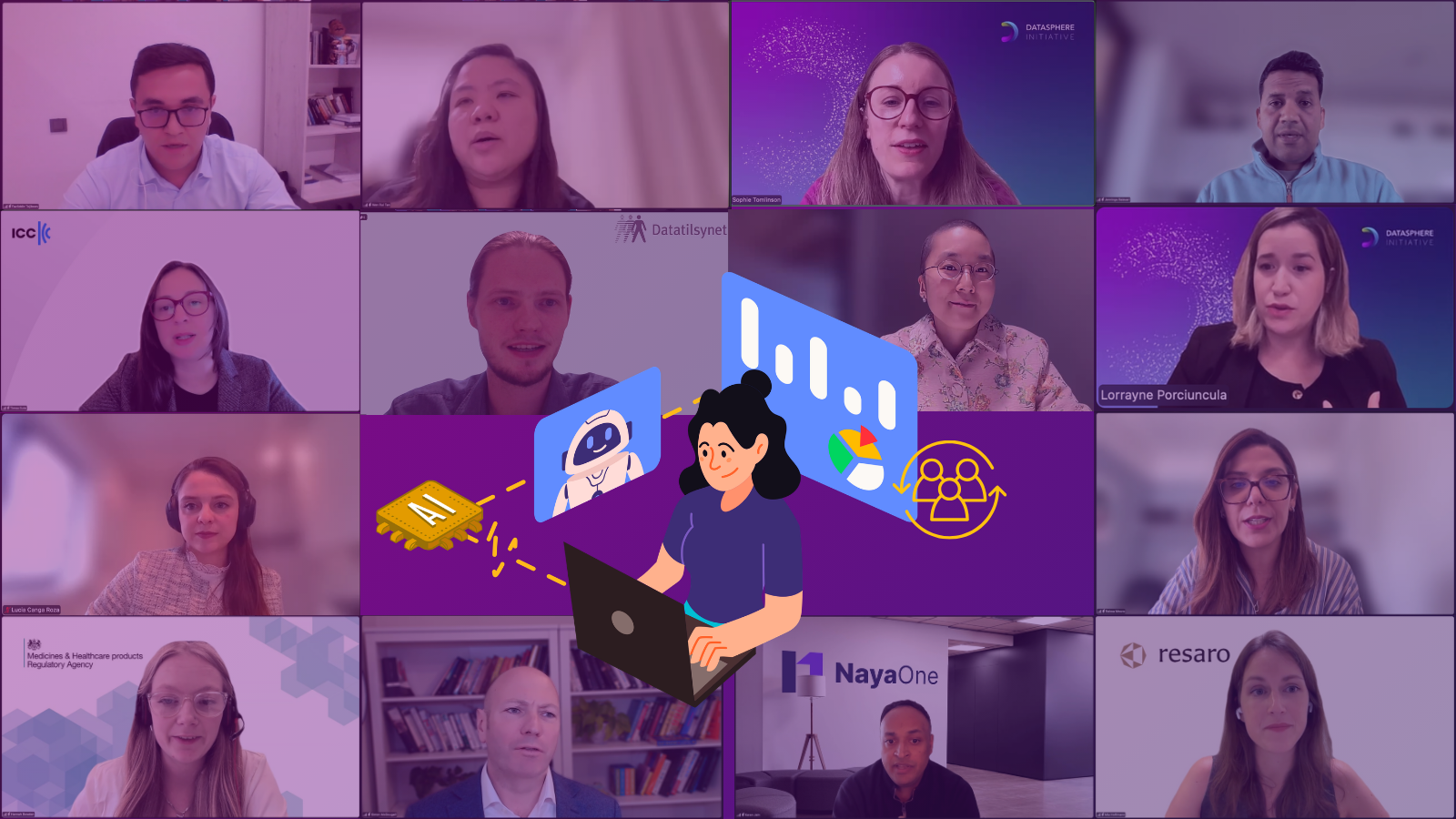

On April 16, The Datasphere Initiative hosted a new Global Sandboxes Forum (GSF) Insights Session focused on business engagement in Artificial Intelligence (AI) Sandboxes. Aiming to foster a rich debate with insights regarding corporate participation in sandboxes, the event brought together sandbox specialists, representatives from the private sector, ranging from Small and Medium-sized enterprises (SMEs) and startups, to major industry players such as Mastercard and Nubank.
Precisely because of this diversity of perspectives and experiences in the market – or perhaps because of the welcoming environment that encouraged the exchange of opinions – the 52 attendees were able to take part in a lively discussion regarding emerging AI sandbox models and practices. The views expressed and experiences shared served as valuable contributions to the Datasphere Initiative’s work on AI sandboxes and its exploration of the roles of the private sector in these tools for innovation.
GSF Insights Session: Business Engagement in AI Sandboxes
The main discussion of the session was focused around the evolving role of AI sandboxes for businesses and how they differ from the other sandboxes and traditional vertical and hierarchical models for AI innovation. The Datasphere’s Executive Director, Lorrayne Porciuncula, opened the session by outlining the rapid global growth of AI sandboxes, noting they have expanded to over 50 initiatives across 38 countries in just a year since the launch of the Sandboxes for AI report in 2025.
From that point on, the debates also explored the value proposition of AI sandboxes for the private sector and delved into the challenges and benefits of the methodology in diverse sectors and business sizes. For Startups and SMEs, for example, AI operational or hybrid sandboxes are seen as the opportunity of gaining access to curated data, top computing power (like high-end GPUs), and expert mentorship that unblocks bureaucratic hurdles and accelerates product development. However, sandbox participation can be resource-intensive, requiring multidisciplinary teams, meaning companies need strong incentives such as legal safe harbors, intellectual property protection, and practical regulatory guidance.
When it comes to multinational corporations, scalability was named the main challenge. While sandboxes offer excellent local collaboration, regulatory comfort gained in a single jurisdiction does not automatically translate into global product acceptance. Consequently, the experts called for greater cross-sectoral coordination and mutual recognition of sandbox outcomes between international regulators.
How AI Sandboxes are helping SMEs by lowering entry barriers and providing secure infrastructure
Fazliddin Tojiboev, from the Digital Economy Research Center under the Ministry of Digital Technologies in Uzbekistan, explained that by providing state-funded AI infrastructure and computing power, his country is actively reducing entry barriers for SMEs to adopt AI. This movement builds safer data infrastructure and helps foster more secure access to valuable data. Karan Jain, Founder and CEO of NayaOne, a platform provider for sandboxes, joined the conversation explaining that an optimized time frame can represent both a financial and strategic window of opportunity for startups without the loss of essential guardrails.
Henrik Netland Svensen, the Sandbox Coordinator at Datatilsynet in Norway, agreed by observing that AI is not only for highly specialized expertise anymore. He believes this movement helps to accomodate a broader, less-specialized base, which breaks down barriers of entry for SMEs and helps them with strategic compliance issues.
AI Sandboxes: beyond data access
Jennings Balavari, the Founder of Opsen AI, who participate in the UK FCA Supercharged AI Sandbox noted that while getting curated data was helpful, the real value came from the ecosystem provided by the sandbox. Workflows, data access and end to end experimentation are excellent, however it is the human input and peer to peer interaction that make a truly satisfactory sandbox experience.
Timea Suto, the Global Digital Policy Lead at the International Chamber of Commerce, agreed with Balavari. In her perspective, peer-to-peer interaction is what’s going to make AI sandboxes even more strategic for the private sector. She understands that businesses should be engaged early in the co-design of sandboxes to help regulators understand where overlapping AI rules create friction in the real world.
The problems emerged from AI Sandboxes and how testing can fix them
When it comes to issues and how to resolve them, Hannah Bowden, the UK AI Airlock Programme Delivery Lead, brought up her perspective by sharing how AI errors are highly multidimensional, and fixing one issue can inadvertently cause another. However, once the sandbox participants shared this understanding, they had an increase in motivation to support testing for candidates’ products, suggesting that the question can be solved by making an effort to understand and deal with the complexity of AI.
Mia Hoffmann, AI Quality Architect at Resaro AI, took that conversation further with her view as an independent tester in Singapore’s AI Assurance Sandbox. She emphasized that data is crucial for good testing and assurance, and if a system is not designed for traceability, it means a lot of its activities will not be available to a tester. Testing, although time consuming, is vital for accurately scoping cases in order for results to be actually predictive nevertheless.
Still regarding testing, Wen Rui Tan, Senior Manager of AI Governance at Singapore IMDA/PDPC, brought up the necessity of a multi-stakeholder setup in sandboxes. Technical testers know how to test, but aligning with business stakeholders to define what to test and integrating the government’s policy perspective is essential. Collaboration across different groups and organizations, to learn and improve collectively, is the way to ensure AI deployment is safe for citizens.
The perspective of multinational companies on how Sandboxes can help
It was Lucia Canga Roza, Senior Managing Counsel (VP) Privacy, AI & Data Responsibility, for Mastercard, who started the conversation on the multinational perspective. She pointed out that the environment for dialogue and testing new ideas created by sandboxes are very strategic for those companies, yet something created in the controlled environment of a sandbox needs to work with the reality of the market, so the efforts go towards a product that actually works. Scalability becomes, in this scenario, the core of sandbox discussion in the perspective of a multinational company.
Raíssa Moura, the Data Protection Officer at Nubank, doesn’t see sandboxes merely as side projects, since they typically require a dedicated multidisciplinary team, which for smaller fintechs and SMEs means that the trade-off can be huge. It is, however, a good tradeoff when it does not take more time from development of products while giving legal certainty and safe harbors. Confidentiality and data protection in a cross cutting tech such as AI is a relevant matter for various stakeholders.
Bringing innovation to the way sandboxes innovate
Simon McDougall, the Chief Strategist for Privacy & AI at ZoomInfo welcomed the perspective of “post-sandboxing”, urging the sandbox organizers to negotiate confidentiality agreements upfront to ensure expectations are aligned early on. He encouraged exploration of how different regulations and governments around the world recognize the discoveries from a sandbox, and how the outcomes could become interchangeable between jurisdictions.
Closing the session, Sam Jungyun Choi, Lawyer at Covington & Burling LLP, touched on the value proposition for companies on whether to participate or not on a sandbox. She explained that a strong connection is needed to persuade a company to participate in a regulatory sandbox. Mutual recognition across jurisdiction, cross-sector sandboxes, and starting the process understanding the most about it, while simultaneously being able to envision the impact, are her perspectives on what could make the idea more appealing to companies. Bringing civil society to the conversation could also help, especially people affected by the decisions on the sandbox, transforming societal expectations in a meaningful way for regulators and businesses to develop adequate and safe innovations.
What can we learn from the other participants insights
It wasn’t only the speakers who got to participate in the debate with valuable insights. Using an interactive tool, the Datasphere’s team gathered the points of view from the attendees on the matter being discussed.
The participants seemed to agree, for example, that sandboxes are promising tools for driving responsible innovation. As for the challenges pointed out, resource constraints, confidentiality or IP protection were the main brought up ones. The main incentive pointed out is the inclusion of clear and predictable regulatory guidance. The Datasphere Initiative also asked the audience for recommendations on how to make AI sandbox learnings and testing more impactful and valuable for businesses. Clarity from regulators was the most common answer. All the visions gathered in the Miro board are on the slider below:
Conclusion
After hearing the speakers and taking a look at the participants’ perspectives, the consensus was that AI sandboxes must move beyond being seen as mere compliance testing methodologies to become trusted, co-creation spaces that can shape practical AI governance and improve real-world regulations. It was clear that, for the private sector, taking sandboxes seriously can be strategic not only for the benefits it will bring to the businesses, but also because that movement is precisely what’s contributing to approaches to AI global governance.
Sessions like these take the wishes for more interactive ways of sandboxing closer to reality.
The Datasphere Initiative would like to thank each participant for another insight session with the power of collectively building new ways of innovating with sandboxes. The ideas and perspectives brought to the meeting will be valuable assets for the further publication of a new Datsphere Initiative report coming in the next few months.