


Global supply chains are currently navigating a regulatory maze consisting of more than 1,000 overlapping ESG standards and regulations worldwide. Managing these intricate compliance requirements creates trillions of dollars in hidden costs and severe administrative friction. Under traditional manual auditing models, identifying real non-compliance risk across jurisdictions remains like searching for a needle in a haystack. This is why the newly launched United Nations Transparency Protocol (UNTP) represents a critical milestone, serving as a live example of global digital public infrastructure in action.
The framework was developed under ‘Transparency at scale,’ a UN/CEFACT project dedicated to creating open, global digital standards for tracking and verifying supply chain data. By establishing a shared technical language for sustainability metrics, this initiative moves the global economy past proprietary barriers to reshape cross-border digital governance and foster sustainable trade.
To ensure this infrastructure scales effectively, the initiative now demands broad global participation during its formal sixty-day public review period closing on 13 July 2026. Technical experts, regulators, and civil society groups worldwide have a unique opportunity to stress-test the specification and co-design the blueprints of trusted data exchange. At the Datasphere Initiative, we look at how this decentralized standard can bridge the gap between high-level policy and real-world implementation.
Navigating a regulatory maze through architectural standards
Global trade is undergoing a profound transformation as new environmental and social standards emerge worldwide. Major frameworks, such as the European Union’s Deforestation Regulation (EUDR) and the Carbon Border Adjustment Mechanism (CBAM), now require deep accountability across entire value chains, tracking sustainability metrics from the raw material origin all the way to the final product.
It is important to recognize and highlight that, at their core, regulations serve important public policy objectives, such as establishing vital guardrails for negative externalities of economic activities and protecting the environment, vulnerable populations or future generations.
The operational challenge, however, stems from a lack of alignment across countries. With more than 1,000 active environmental, social, and governance (ESG) standards globally, the absence of shared technical frameworks forces suppliers to manage redundant reporting and repetitive audits for highly similar metrics when exporting to multiple markets.
Managing this complex web of global rules requires a fundamental shift in how compliance data flows across borders. Traditional traceability methods typically expect every participant in a value chain to register on the exact same corporate software platform or centralized database to pool information. This approach creates high integration costs and operational barriers that heavily disadvantage smaller suppliers who cannot afford complex technology updates.
The UNTP addresses this structural gap by serving as an open, universal standard rather than a private application. Because it functions as a shared digital language, supply chain information stays entirely under the secure control of the businesses that actually generate it. This allows organizations to format, link, and verify their compliance records globally while continuing to use whatever basic internal technology they already have in place.
Ultimately, this open design eliminates repetitive reporting and cuts daily operational costs. Instead of running redundant audits for different buyers, a business can verify a sustainable practice just once and safely reuse that same data to satisfy multiple overlapping global regulations at the same time. This practical shift transforms data governance from a corporate burden into a shared public utility, anchoring a broader transition toward an open and equitable digital public infrastructure.
Digital public infrastructure in action: Building open systems
Digital public infrastructure represents the society-wide digital capabilities that are essential to modern economic and social life. These foundational networks typically converge around three core operational layers, which are digital identity, digital payments, and data exchange. Globally, a growing political consensus positions this infrastructure as a critical development accelerator, a stance strongly championed by successive G20 Presidencies and the United Nations Global Digital Compact.
When designed and governed responsibly, these shared platforms can dramatically expand access to public services, reduce commercial transaction costs, and close deep digital divides. However, because these population-scale infrastructure choices are exceptionally difficult to reverse once deployed, their technical architectures carry unusually high stakes for public trust and human rights. The UNTP framework directly instantiates these systemic principles, demonstrating how decentralized data exchange can function as a transparent public utility to automate transaction compliance.
The protocol operationalizes this public infrastructure by organizing value chain data into five decentralized building blocks. Product passports carry granular item or batch-level data, facility records securely map processing sites, conformity credentials provide independent trust, traceability events link material flows, and identity anchors verify participating actors.
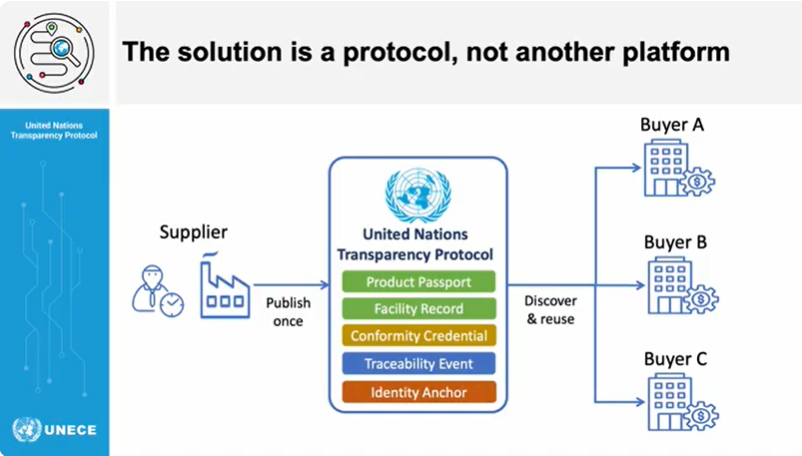
System overview of how the UNTP protocol decentralizes supply chain data, as featured in the UNTP business overview video.
Together, these blocks allow reliable supply chain metrics to emerge natively from the bottom up, shifting the focus away from closed software applications toward open, interoperable public systems.
To explore how public authorities are safely implementing these frameworks, read the Datasphere Initiative’s report, Sandboxes for DPI: Co-creating the blocks of digital trust. This comprehensive 2026 study provides a first of its kind empirical mapping of sixteen sandbox initiatives operating across the globe. The analysis investigates how structured, upstream experimentation can successfully manage operational risks, build public sector capacity, and strengthen societal trust before digital systems are deployed at population scale.
Equitable market access: Unlocking positive impacts for business and SMEs
The UNTP decentralized data framework creates a powerful foundation for equitable market access across the global trade ecosystem. High entry costs and administrative burdens associated with proprietary tracking platforms often penalize small and medium enterprises (SMEs), particularly within emerging economies.
The UNTP addresses this systemic imbalance by providing a low-cost, open-source utility that allows upstream suppliers to capture and verify data once, then reuse it across multiple global buyers. This structural democratization prevents smaller actors from being priced out of high-value, sustainability-focused value chains.
Balancing transparency with confidentiality creates clear advantages for businesses. By allowing companies to protect competitive data, the protocol lets them share verified ESG proof downstream without exposing sensitive details like profit margins or supplier relationships. As a result, businesses can easily prove they meet global rules, safeguarding both their market access and their commercial privacy.
Global participation: Co-designing future standard blueprints
Scaling these workflows from a reference specification into an effective global framework depends entirely on open, inclusive participation. The formal public review window, open until 13 July 2026, represents the critical window to drive this global participation. Active engagement from technical specialists and regulatory bodies will ensure that the final data exchange standards reflect diverse operational realities on the ground.
Finally, testing these blueprints in varied economic sectors will help prevent technical bias and ensure that the protocol remains vendor-agnostic. Broad collaboration during this phase is what will transform a standard from a passive technical document into a resilient public asset.
Learn more about the UN transparency protocol