
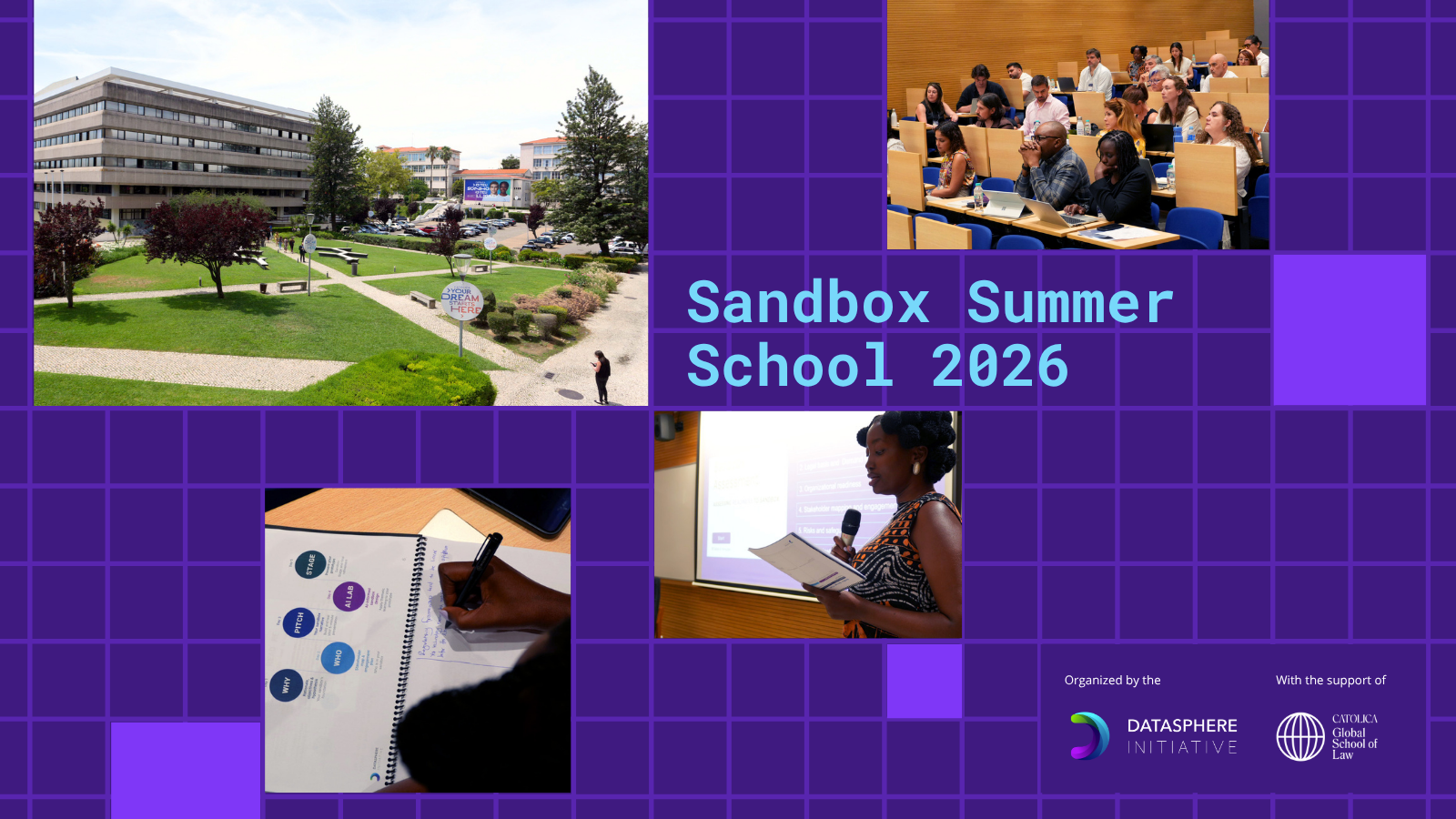

The intensive five-day program in Lisbon gives public and private sector leaders the practical skills and confidence to run effective sandboxes
Lisbon, Portugal, July 13, 2026 — The Datasphere Initiative, in partnership with the Católica Global School of Law, has officially launched the second edition of its Sandbox Summer School in Lisbon, Portugal. This specialized five-day governance laboratory builds directly on the successful track record established during the inaugural 2025 cohort, which united diverse professionals from 19 countries.
The core mission of the program is to strengthen public and private sector capacity for responsible data innovation. As emerging technologies expand at a velocity that outpaces legacy legal frameworks, the school establishes a critical and neutral space where technical innovation and public interest oversight safely align.
Pioneering a collaborative governance model
Traditional top-down, hierarchical policy approaches often struggle to manage the complexities of a highly fragmented digital ecosystem. This lag creates dual friction: public agencies face intense pressure to protect digital rights, while startups and small enterprises must navigate unpredictable legal and policy landscapes.
To close this operational gap, governments and companies worldwide are turning to sandboxes, which are controlled environments designed for structured experimentation. However, the institutional expertise required to deploy these testing spaces effectively remains scarce. The Sandbox Summer School addresses this gap directly as the first global training program focused on transforming sandbox concepts into actionable, localized frameworks.

“The Sandbox Summer School was never meant to be just another training. We design every session with the intention to create a space where people don’t just learn — they care, question, experiment, and build together. We believe that bold ideas inspire more bold ideas, that people who care bring out the best in one another, and that meaningful change begins when we create communities of action, not passive audiences. If participants leave with new knowledge, renewed purpose, and the confidence to tackle real-world challenges together, then we’ve accomplished what we set out to do.” Lorrayne Porciuncula, Executive Director.
A hands-on, cumulative learning framework
Rejecting the traditional model of passive, lecture-heavy seminars where attendees simply take notes, the program operates as an immersive design lab. Participants actively master every phase of the sandbox lifecycle by leveraging the methodology developed by the Datasphere Initiative.
The structural curriculum is executed through a cumulative daily progression that challenges each individual to bring a real-world institutional problem from their home country and shape it step-by-step into an implementable solution. This intentional daily arc includes:
- The foundation: Isolating and defining the core regulatory or operational challenge (the sandbox “why”).
- The ecosystem: Mapping the complex network of stakeholders, affected communities, and necessary partners (the sandbox “who”).
- The strategy: Translating dense technical and legal mechanics into a clear, persuasive institutional narrative (the “pitch”).
- The prototype: Refining a prototype targeting a distinct, high-friction operational bottleneck.
This rapid iteration is enriched by a tight-knit global community of practice. Working side-by-side with international peers, civil servants, civic technologists, and corporate professionals collaborate with assigned expert mentors. These sessions break down geographic and sectoral silos, allowing participants to challenge early assumptions through rigorous feedback loops.
Bridging policy with the new artificial intelligence and business report
While the 2026 program covers high-level sandbox applications across vital sectors, including artificial intelligence, digital public infrastructure, fintech, healthcare, and municipal governance, it avoids narrow specialization to maintain a holistic overview of experimental governance.
To anchor these cross-sector discussions in data-driven evidence, the program features an in-person launch event in Lisbon for the Datasphere Initiative’s latest research publication, “AI sandboxes and the private sector: emerging models and practices“. This specialized briefing represents a global first on the topic, shifting the traditional public-sector narrative to systematically evaluate how businesses interact with agile governance. Drawing on a comprehensive mapping of 90 AI sandboxes worldwide, the report analyzes the distinct operational roles companies assume as participants, technical providers, or platform hosts, and introduces a practical checklist to guide corporate risk assessment before entering a sandbox.
Sustaining a global community of practice
The long-term impact of this five-day laboratory rests on the enduring network. Debuting last year as the first training program of its kind, the initiative proved that a hands-on workspace could successfully empower practitioners to navigate complex digital environments.
Sandboxes are proving to be far more than isolated policy experiments; they are the architectural building blocks of digital trust required to safely pilot the next generation of artificial intelligence, digital public infrastructure, and cross-sector innovation. By shifting the paradigm from rigid regulation to agile co-design, these controlled environments offer a neutral framework where public regulators, enterprise technical teams, and civil society can systematically isolate operational friction, manage technological risk, and gather empirical evidence before scaling solutions.
This is precisely where the Sandbox Summer School fulfills its critical field-building mission. Rather than delivering passive, lecture-heavy instruction, the laboratory acts as a capacity-building engine that empowers global practitioners. Through adaptable methodologies and by establishing a dedicated global training environment, the program bridges the gap between abstract text and participants’ local and institutional challenges.