


“The inspiration behind having the Summer School was twofold. We want to advance the field of sandboxes — what we call building a science — but we also want to create a community. Those two things reinforce one another.”
— Lorrayne Porciuncula, Executive Director of the Datasphere Initiative.
Navigating fast-moving digital innovation is increasingly a test of institutional adaptability.
Whether governments are responding to artificial intelligence, digital health, financial innovation, or cross-border data sharing, they increasingly face the same problem: they must make decisions under uncertainty. Traditional policymaking often assumes that rules can be designed before experience. But many of today’s challenges demand something different: institutions capable of learning while doing.
That is why sandboxes are attracting growing attention around the world. Sandboxes are about bringing together institutions that do not usually work together, testing ideas before they become policy, navigating uncertainty and creating enough trust for experimentation to happen. Those capabilities cannot be developed through lectures alone. Trust isn’t built overnight, it is built through practice, reflection exchange and the desire to solve common problems between actors.
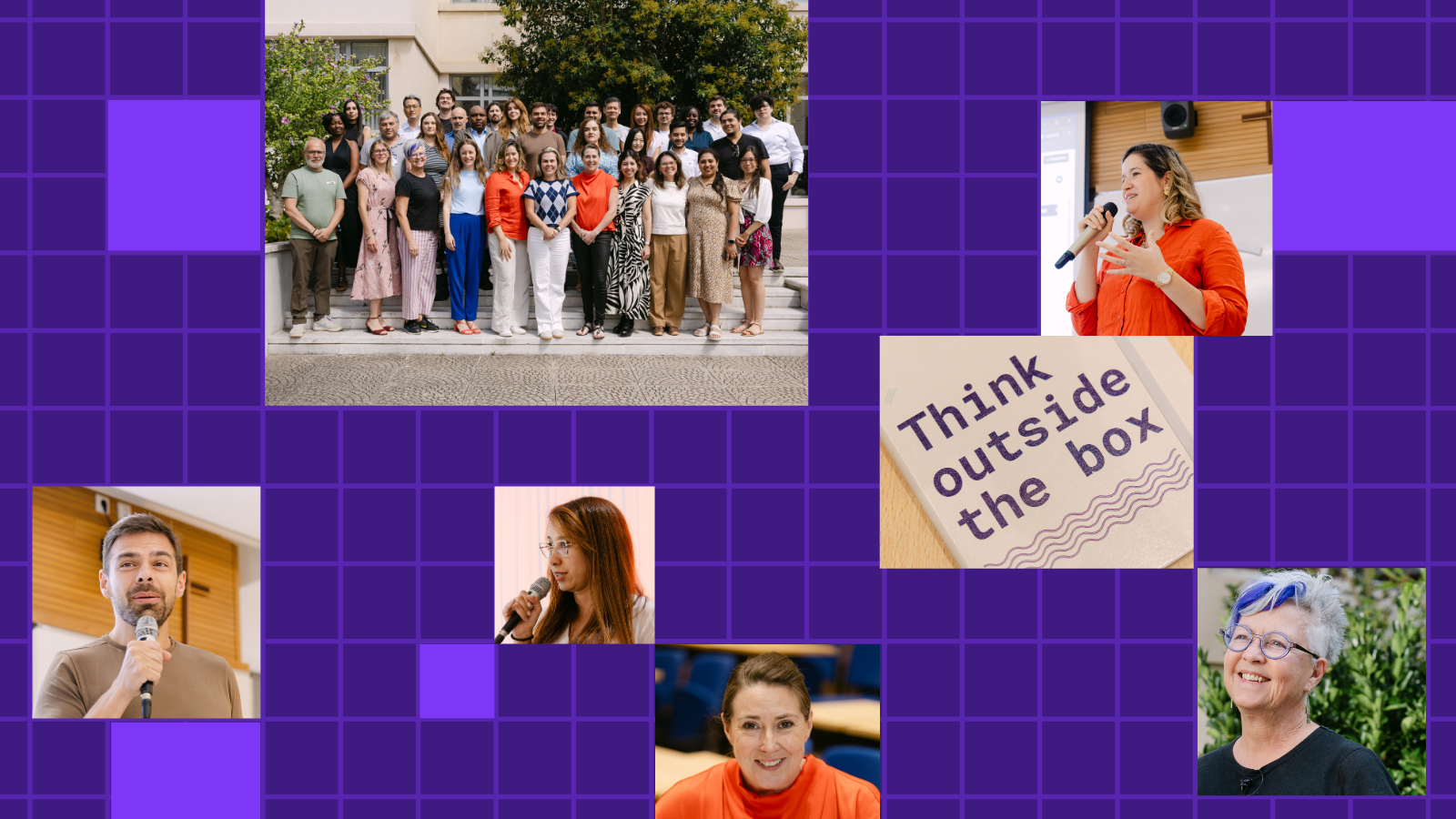
That philosophy shaped every part of the Sandbox Summer School, co-hosted with Católica Global School of Law at Universidade Católica Portuguesa in Lisbon. Over five days, 43 participants from 19 countries representing ministries, regulatory authorities, international organisations, academia, civil society and the private sector worked alongside practitioners who have designed sandboxes in areas ranging from artificial intelligence and financial regulation to health, digital public infrastructure and telecommunications.
Rather than following a traditional training format, the programme invited participants to work on challenges drawn from their own institutions, gradually transforming them into sandbox prototypes through discussion, coaching and iteration.
Learning sandbox design from global regulatory practitioners
One of the distinguishing features of the Summer School is its learning model. Rather than separating theory from practice, the programme combines foundational concepts, implementation methodologies, real-world case studies, sector-specific deep dives and hands-on exercises that allow participants to apply what they are learning to real governance challenges.
Throughout the week, participants engaged with speakers and panelists who have designed, implemented and evaluated sandboxes across different sectors and jurisdictions. Drawing on experiences from organisations such as the UK’s Financial Conduct Authority, the Central Bank of Ireland, the Korean Development Institute, the UK AI Airlock, the Norwegian Data Protection Authority, and the Colombian Communications Regulatory Commission, discussions went beyond success stories to explore the institutional trade-offs, governance dilemmas and implementation challenges that rarely make it into policy papers.
These conversations were woven together through a series of prototype activities facilitated by the Datasphere Initiative team. Working in small groups, participants received continuous guidance and feedback as they translated new ideas into sandbox concepts tailored to their own institutional contexts.
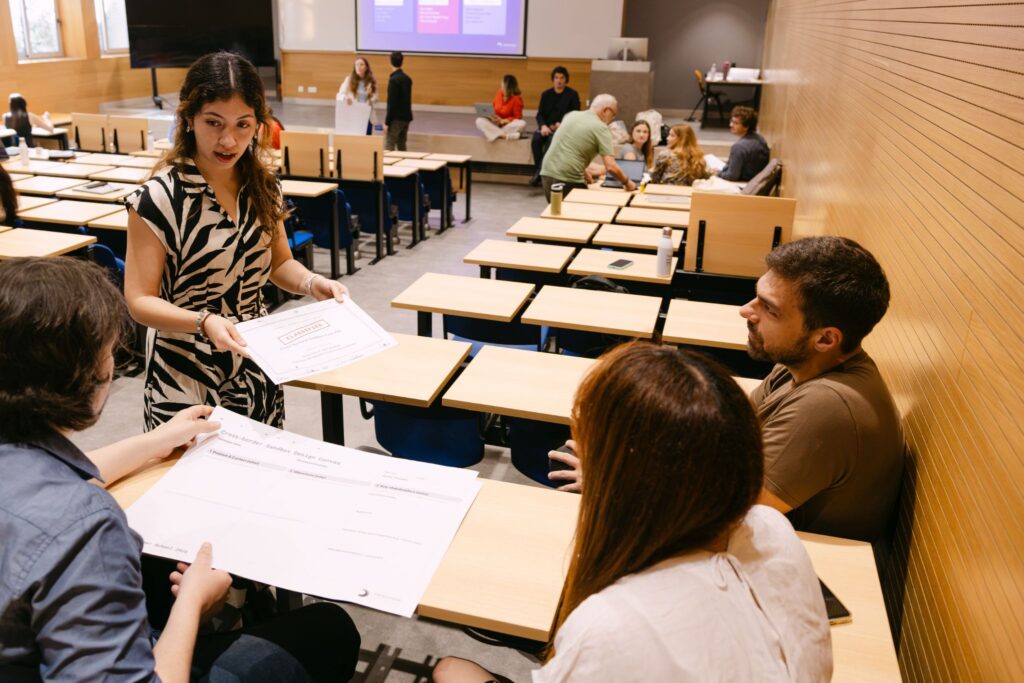
Participants work through a cross-border sandbox simulation, tackling cross-border governance challenges facilitated by Mariana Rozo-Paz (Datasphere Initiative). The exercise encouraged participants to step into new regulatory contexts, collaborate across sectors and design practical solutions together.
The program itself mirrors the lifecycle of a sandbox. Participants begin by asking why a sandbox is needed and what’s required to set it up, identify who needs to be involved, explore communication and governance strategies, refine implementation models, and determine how to effectively evaluate metrics and close or scale the sandbox, while progressively refining their own prototypes Every discussion feeds directly into a practical exercise, and every exercise becomes another building block for the participants’ own projects.
For Daniela Guzmán Rojas, from Colombia’s National Planning Department, that progression fundamentally changed how she thought about her own work.

“My knowledge of sandboxes was very limited before coming here. I learned not only the theory, but also how they work in practice in different countries. Throughout the week I kept thinking about how this could be implemented in my own context. At first, I thought it would be difficult to apply it to my work, but as the days went by everything became much clearer. I leave with methodologies and planning frameworks that I can start using from day one when I return.”
Her experience reflects one of the programme’s central ambitions: not to provide a blueprint, but to equip participants with the confidence and practical tools to design solutions that fit their own institutional realities.
Fostering cross-sector collaboration
Although participants came from different sectors and regions, many found themselves grappling with remarkably similar questions.
How do you create space for experimentation within existing regulatory frameworks? How do you bring industry into the process? How do you engage citizens and other stakeholders? How do you generate evidence before making decisions? How do you work across government departments, ministries, or authorities?
Those conversations often became just as valuable as the formal sessions.
Carole Donaghy, who leads the Innovation Sandbox Programme at the Central Bank of Ireland, captured that shared experience.

“Across the globe and across industries, we’re facing the same problems. We’re solving different challenges, but we need to collaborate and learn from each other. Through sandboxes, we’re finding an incredible tool that facilitates that collaboration. The exchange of information and knowledge has been second to none, and the openness of the participants has been exceptional.”
What emerged over the course of the week was not a single model for building sandboxes, but something arguably more valuable: a broader understanding of what is possible.
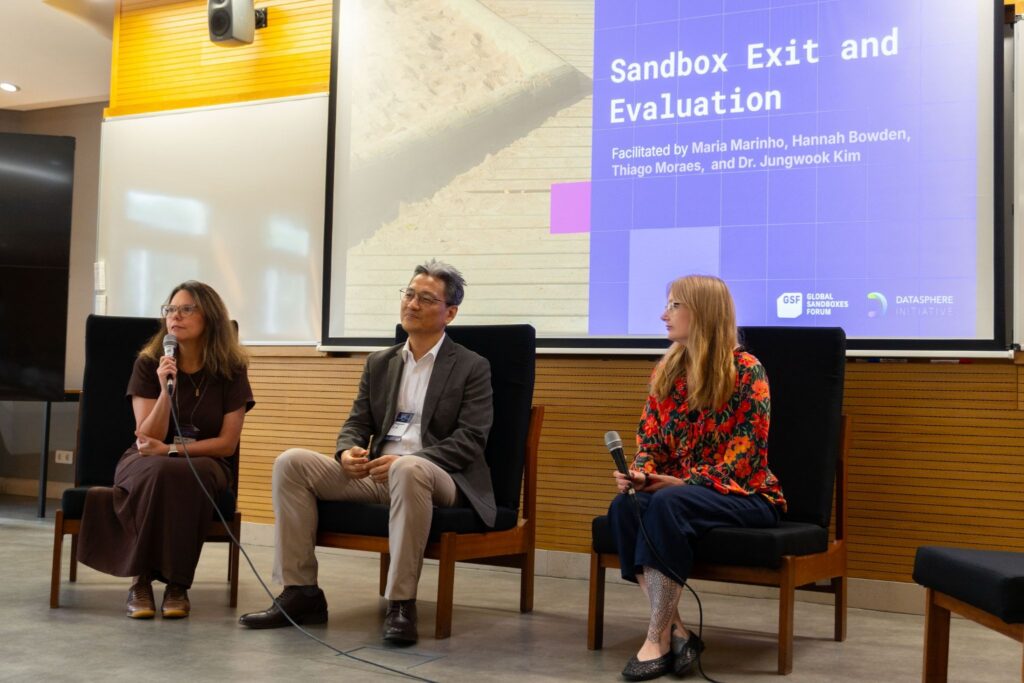
Sessions throughout the week brought together practitioners from different sectors and jurisdictions, allowing participants to compare implementation experiences and adapt lessons to their own contexts. Here, Maria Marinho (Datasphere Initiative), Dr. Jungwook Kim (Korea Development Institute) and Dr. Hannah Bowden (UK AI Airlock) discuss how sandboxes are evaluated in practice.
Participants working on AI governance learned from financial regulators. Public officials designing digital public infrastructure explored approaches developed in healthcare. Civil society organisations exchanged ideas with ministries and data protection authorities. Crucially, this exchange was enriched by the geographic diversity of both cohort and faculty, bringing together practitioners from countries across Africa, Asia, Europe, and the Americas. Exposure to different governance traditions expanded not only participants’ knowledge, but also the range of approaches they could imagine bringing home.
Anchoring policy in evidence: Launching our new AI sandboxes report focusing on private sector engagement
While cohort discussions focused on local implementation, the week also marked a key milestone for global research on technology governance. On the sidelines of the Summer School, the Datasphere Initiative officially launched the report AI sandboxes and the private sector: Emerging models and opportunities. Presented to international policymakers and innovators in Lisbon, the study addresses a critical gap in current literature by examining why and how commercial actors enter experimental environments.
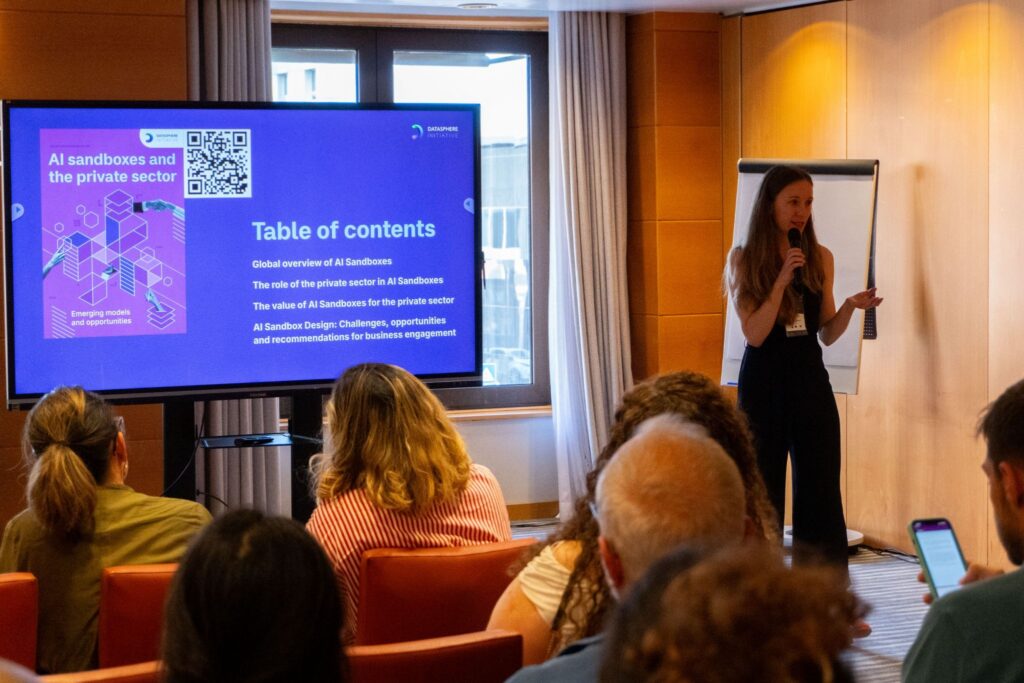
Sophie Tomlinson, Deputy Executive Director of the Datasphere Initiative, presents key findings from the new report AI Sandboxes and the Private Sector, launched during the 2026 Sandbox Summer School.
Drawing on an updated global inventory of 90 AI sandboxes, the report outlines the three distinct roles companies assume as participants, technical providers, or platform hosts. It also introduces a practical business participation checklist to help teams evaluate risks and incentives before entering a sandbox. By aligning this release with the Summer School programming, participants gained immediate access to fresh global data, offering valuable industry context to inform their prototype discussions throughout the week.
Building a global community of practice
By Friday, every participant had developed a prototype grounded in a real institutional challenge. But the prototypes were never intended to be the programme’s final output.
Anne Collier, Founder of the Net Safety Collaborative, perhaps explained it best.

“A sandbox really takes multiple perspectives. Whether it’s technology like AI or another area entirely, you need different voices around the table. The Datasphere Initiative has brought together an amazing mix of perspectives, cultures and people who are learning together, designing together and, as we’ve joked all week, sandboxing the sandbox.”
That mix of perspectives is intentional. Sandboxes are collaborative by design, and learning how to build one means learning how to work across institutional, disciplinary and geographic boundaries. The relationships formed during the Summer School are therefore not an informal by-product of the programme; they are part of its methodology.
Rafael Carvalho, from the Attorney General’s Office of the State of São Paulo in Brazil, reflected on what that means once participants return home.

“One of the key aspects of any successful innovation programme is an active community of practice. This Summer School is a wonderful opportunity to build one and to meet people who are facing many of the same challenges as you are in your own country.”
Translating sandbox prototypes into long-term policy impact
The final morning is dedicated to presentations. Participants pitch the sandbox prototypes they have been developing throughout the week before returning to their institutions with new tools, new questions and new collaborators.
In that sense, the Summer School is designed with a simple premise: the real measure of success is not what happens in Lisbon. It is what happens afterwards.
Some participants will use what they learned to launch new regulatory sandboxes. Others will adapt the methods to operational sandboxes, innovation programmes or public sector experimentation. Many will continue conversations that began around workshop tables, coffee breaks and prototype sessions, reaching back to peers they met in Lisbon when they encounter new challenges.
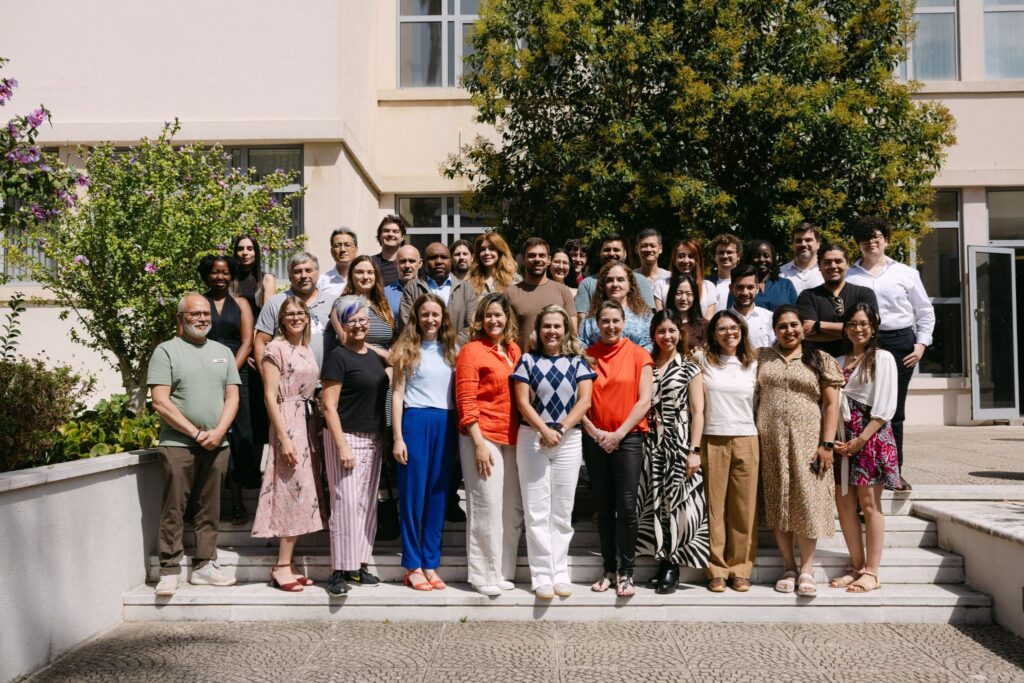
Participants, speakers and the Datasphere Initiative team at the close of the 2026 Sandbox Summer School. Alongside new tools and prototypes, participants leave with a global network of peers tackling similar governance challenges.
Building better sandboxes ultimately depends on more than good frameworks. It depends on people who have learned from one another, challenged one another and built enough trust to keep experimenting together long after the classroom is empty.
Scaling agile governance through the Datasphere ecosystem
The Summer School represents a high-visibility moment of intensive co-creation, but it is just one component of a continuous, year-round effort. Beyond Lisbon, the Datasphere Initiative is advancing an ambitious roadmap to deepen sandbox knowledge and expand practical support for institutions worldwide.
Upcoming releases include a comprehensive global sandbox mapping and upgraded sandbox design methodologies, providing practitioners with updated empirical data and structured frameworks for implementation. The Datasphere Initiative is also carrying these insights into major international and regional convenings, ensuring that practitioner experiences directly inform global policy dialogues.
Through custom facilitation, co-creation labs, and new capacity-building programs, we continue to scale its support across regions. Stakeholders and practitioners are invited to stay involved to access upcoming tools, research, and collaborative opportunities.