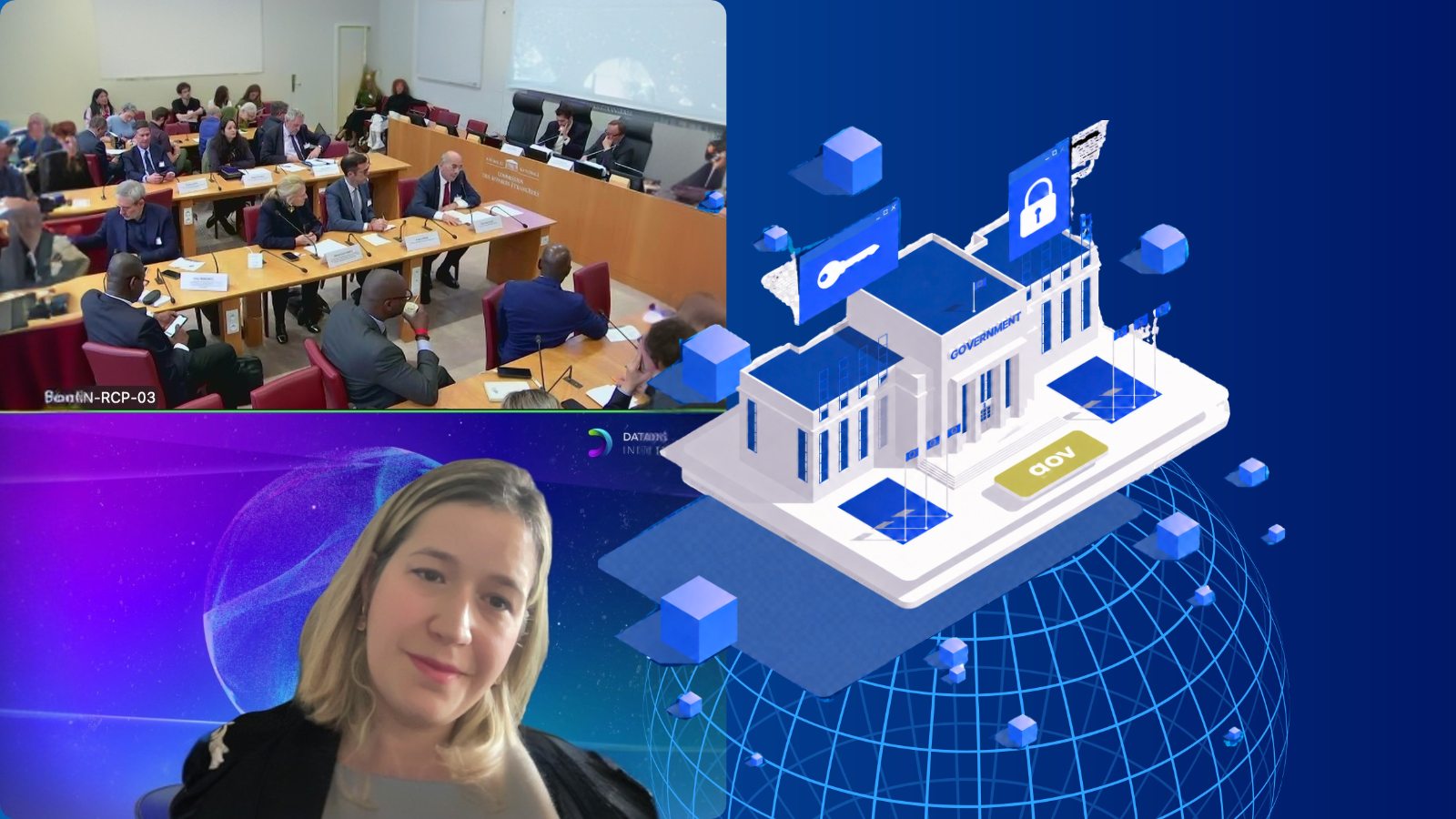

PARIS — October 19, 2026 — Speaking at an international symposium at the French National Assembly, Lorrayne Porciuncula, Executive Director of the Datasphere Initiative, represented the organization to address emerging models of international cooperation and digital governance.
The high-level event, titled “Can Multilateralism and International Cooperation Still Be Saved?”, convened global leaders and policy experts to discuss solutions to increasing gridlock in traditional intergovernmental frameworks. Held in Paris under the patronage of Bruno Fuchs, Chair of the Foreign Affairs Committee, the symposium was organized as a soft-launch of the Observatory on Multilateralism and the Future of International Cooperation (IRIS), founded and led by Jean-Christophe Bas.
Porciuncula was a featured speaker in Panel 3, “Overcoming the Gridlock in Multilateralism: New Ways to Cooperate,” which examined innovative approaches to global governance operating alongside or beyond conventional state-to-state diplomacy. Dedicated to the memory of her late co-founder and digital diplomacy pioneer Bertrand de La Chapelle, her address outlined three primary operational pillars for updating international collaboration:
1. We need new principles for digital governance
The foundations of today’s international cooperation were established in a very different world. Rooted in Westphalian principles of state sovereignty and territorial jurisdiction, the multilateral system was designed around clearly defined borders and governments as the primary actors in international affairs.
However, the rapid expansion of the internet and digital technologies has challenged this model. As digital interactions increasingly transcend borders and private actors exercise growing influence over global rules and standards, traditional state-centered approaches are struggling to keep pace, contributing to the broader crisis of multilateralism.
Addressing this challenge requires rethinking how decisions are made and who participates in shaping them.
Drawing on lessons from internet governance, Porciuncula highlighted the importance of multistakeholder cooperation, which brings government, civil society, the private sector, the technical community, and academia into policy discussions. She pointed to the São Paulo Multistakeholder Guidelines, developed as part of the NetMundial 10+ with substantial support and leadership from Bertrand de la Chapelle, as a practical framework for translating principles of inclusion, transparency, and collaboration into governance processes.
2. We need a new mindset for dealing with new global challenges
Many of today’s global challenges, from digital transformation to climate change and artificial intelligence, involve complex systems that transcend national borders, sectors, and jurisdictions. Within these systems, governments, businesses, technologies and individuals interact in ways that are constantly evolving and difficult to predict.
Decisions made in one part of a system can trigger unintended consequences elsewhere, generating ripple effects and feedback loops that extend far beyond their original scope.
Addressing this complexity requires a fundamental shift in mindset: moving away from linear approaches to systems thinking, which recognizes interdependencies and considers how different actors, decisions, and processes influence one another. At the Datasphere Initiative, this perspective informs the concept of the datasphere, which treats data governance as “the complex system encompassing all types of data and their dynamic interactions with human groups and norms”.
For Porciuncula, this shift also has important implications for international cooperation. No single government, institution, or stakeholder can fully understand or control the dynamics of a complex system. Effective governance, therefore, requires recognizing shared interdependencies, anticipating unintended consequences, and developing more coordinated and adaptive responses to global challenges.
3. We need new tools to complement traditional multilateral fora
While digital transformation has fundamentally reshaped how societies interact, innovate, and cooperate across borders, the institutions and mechanisms supporting international collaboration have not evolved at the same pace. Traditional multilateral fora remain essential, but they need to be complemented by new forms of cooperation that allow stakeholders to experiment, learn collectively, and develop more agile and practical responses to shared challenges.
Porciuncula emphasized that changing principles and mindsets is not enough without the institutional tools to put them into practice. One promising approach is the use of sandboxes: controlled environments where stakeholders can collaboratively test technologies, governance approaches, and policy solutions under defined conditions and safeguards. By bringing together governments, regulators, businesses, researchers, and civil society, sandboxes create opportunities to experiment, generate evidence, and learn collectively before adopting solutions more broadly.
Learn more with our 5-min intro to sandboxes.
This approach is already informing the Datasphere Initiative’s work on international cooperation, including sandbox strategy development for the African Continental Free Trade Area (AfCFTA) and for ASEAN member states. These efforts illustrate how collaborative experimentation can help stakeholders navigate shared challenges and explore governance solutions across national borders.
Ultimately, overcoming the current gridlock in multilateralism requires more than reforming existing institutions. It calls for new principles that broaden participation, a systems-based mindset that recognizes global interdependencies, and practical tools that turn cooperation into collective action. Together, these approaches can help build a more inclusive, adaptive, and effective system of international cooperation, complementing traditional multilateral fora while responding to the realities of an increasingly interconnected world.
Symposium speakers & panel participants
Panel 3 was moderated by Sofiane Zaizoune, reporter at POLITICO, and featured co-panelists Marie-Claire Daveu (Chief Sustainability and Institutional Affairs Officer, Kering), Jean-Pierre Gire (Ambassador of the Gravissimum Educationis Foundation and Coordinator of the Global Compact on Education), and Franck Paris (Director-General of the Paris Peace Forum). Concluding remarks were delivered by Jean-Christophe Bas, Director of Observatory on Multilateralism and the Future of International Cooperation and Vice-Chair of the Aspen Institute.
Wider symposium proceedings featured contributions from international figures including Jean-Noël Barrot, Minister for Europe and Foreign Affairs; Pascal Lamy, former Director-General of the World Trade Organization; and Arancha González Laya, Dean of the Paris School of International Affairs and Former Minister of Foreign Affairs, European Union and Cooperation of Spain.
About the Datasphere Initiative
The Datasphere Initiative is a global non-profit think-and-do tank dedicated to building holistic, agile, and inclusive governance models for complex systems such as data and artificial intelligence. Through research, coalition-building, and operational tools like sandbox frameworks, the Initiative works to unlock the value of data for all while protecting human rights and global stability.